

Gutters are easy to ignore. They’re up high, out of sight, and they don’t ask for attention until something goes wrong. The trouble is that when they do go wrong, it tends to be expensive, and at the worst time. A little routine care goes a long way, so here’s what’s worth knowing, including a straight answer on those gutter guards you’ve probably been pitched.
Why gutters matter more than they get credit for
The whole job of a gutter is to catch the rain coming off your roof and carry it away from your house. When they clog with leaves and debris, that water has nowhere to go. It spills over the sides and pours down right against your foundation.
That’s where the real damage starts. Overflowing gutters can lead to foundation problems, wood rot in the fascia and soffits, water in the basement or crawlspace, and even damage to the roof edge itself. Around here in Southern Oregon, where the winters bring steady, soaking rain, clogged gutters get tested hard. A clog you ignored in October can turn into a soggy, expensive problem by January.
Simple maintenance that prevents big headaches
You don’t need to be an expert to stay ahead of it. A few habits cover most of it:
- Clear them once or twice a year. Late spring and again in the fall, after the leaves have come down, is the classic timing. If you’ve got a lot of trees overhead, you may need to check more often.
- Don’t forget the downspouts. A clean gutter still won’t drain if the downspout is plugged. Make sure water actually runs through and exits well away from the house.
- Look for warning signs. Sagging sections, peeling paint or streaks below the gutter, pooling water near the foundation, or plants sprouting in the gutter all tell you it’s time.
- Be smart about ladders. This is genuinely the riskiest part. Use a stable ladder on level ground, have someone spot you, and if your home is two stories or the roof is steep, it’s completely reasonable to call in help rather than risk a fall.
So, should you get gutter guards?
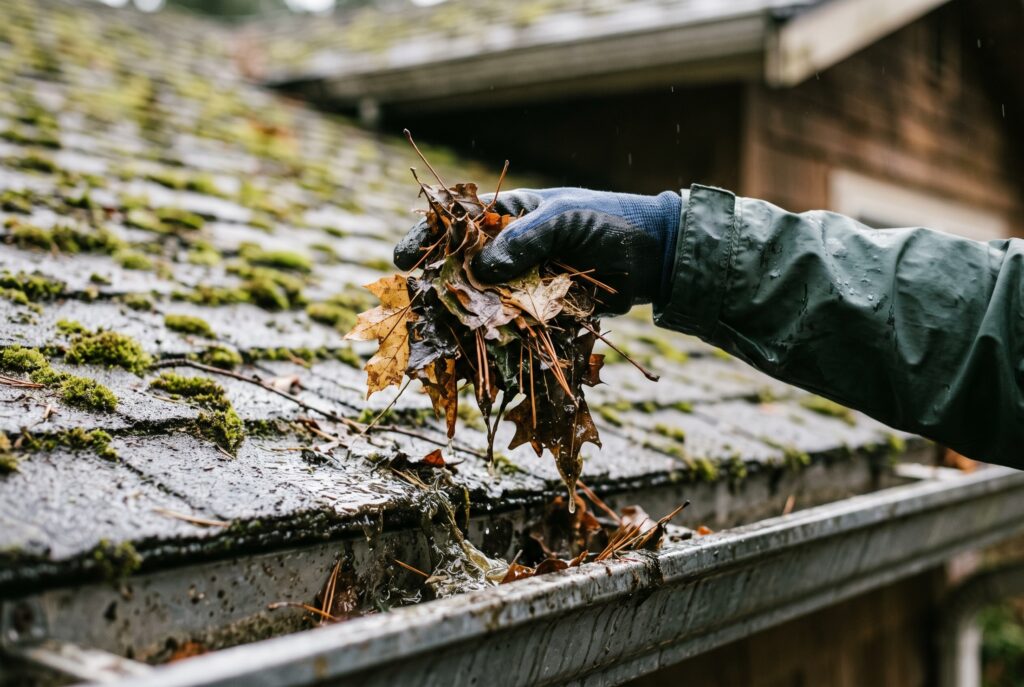
This is the big question, and the honest answer is: they help, but they’re not the magic fix the ads suggest. Here’s the balanced version.
The upside is real. A good guard, properly installed and matched to your roof, can cut down how often your gutters need cleaning, sometimes significantly. That’s a genuine benefit.
But here’s what the sales pitch tends to leave out:
- They’re not maintenance-free. This is the big one. No guard makes cleaning go away entirely. Fine debris like pine needles, seeds, shingle grit, and dirt still slips through or piles up on top.
- The guards themselves need cleaning. Debris collects on the surface, and some types are a real chore to remove and clean, occasionally needing a pro to do it right.
- Heavy rain can defeat some designs. Certain reverse-curve styles can let water shoot right over the edge in a hard downpour, which is exactly when you need the gutter working.
- Cheaper types wear out. Foam inserts in particular act like a sponge, trapping fine debris and breaking down over time in the sun and weather.
- They can create a false sense of security. This is the sneaky cost. Because people assume the guards have it handled, they stop checking, and small problems quietly grow into big, costly ones behind the scenes.
- Quality guards aren’t cheap. A good system professionally installed is a real investment up front.
Our take: guards can be worth it for the right home, especially under heavy tree cover, as long as you go in knowing they reduce maintenance rather than eliminate it. Just keep checking your gutters either way.
When you’d rather not climb up there
Gutter cleaning is dirty, awkward, and the ladder work carries real risk. If it’s not how you want to spend a weekend, we’re glad to handle it. Our gutter cleaning service clears everything out and checks that it’s flowing properly, and you can get a quick estimate with our gutter calculator. While we’re up there, ask about moss removal too, since our damp climate is hard on roofs.